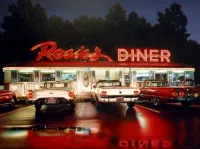
The work of these artists, including Chuck Close, Robert Bechtle, Richard Estes, John Salt and Franz Gertsch is painted in such minute detail and with such precision that they resemble photographs. The result, however, is more than a virtuoso copy of the subject, and the paintings create their own reality. The exhibition at the Kunsthal presents, for the first time ever, the full scope of this genre and includes all the great names associated with it, not forgetting the latest generation of artists, such as the Dutch painter Tjalf Sparnaay.
Photography as the source
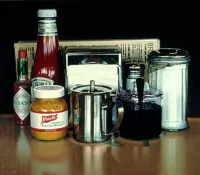
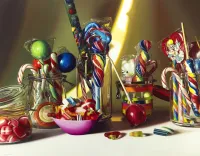
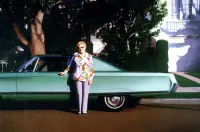
Hyperrealism - also known as photorealism - dates back to the late 1960s in America and evolved in response to the dominant trend of abstraction, minimalistic and conceptual art at the time. After the Pop Art movement, and as a result of the growing consumer society, a group of young American painters began using everyday lives and objects as the subject of their work. They used photographs as a source and reproduced existing images meticulously on canvas, from close-ups of car bumpers, shiny paintwork and dazzling chrome, colourful children’s toys and sweets, to the interiors of American diners with salt shakers and tomato ketchup bottles, and scenes of urban life: neon advertising, urban vistas and landscapes, reflections in shop windows and enormous portraits. Ever since they appeared, these paintings of everyday scenes and enlarged consumer goods have attracted much attention from admirers and critics alike. The work originally raised the question of whether it was art or simply a representation of reality, but this art movement now has a strong and enthusiastic following.
Take a really good look
The overview of almost 50 years of hyperrealism illustrates not only how the subject choice has changed, but also how the technology with which photorealists produce their work has changed: they first transformed images from celluloid into oil paint, and nowadays from digital pixels to acrylic paint. The sharpness of the paintings has further increased in tandem with the resolution of the photographs. It is interesting to note that the photorealistic paintings ‘force’ viewers, as it were, to take a really good look at them. The abundance of images with which we are surrounded these days means that we don’t always take the time to observe properly, and the digitisation of photography also gives rise to the question of what is real and what has been manipulated. The paintings in the exhibition ‘Hyperrealism’ go just that bit further.
Artists featured in the exhibition
First-generation: John Baeder, Robert Bechtle, Charles Bell, Tom Blackwell, Chuck Close, Robert Cottingham, Don Eddy, Richard Estes, Audrey Flack, Franz Gertsch, Ralph Goings, John Kacere, Ron Kleemann, Richard McLean, Jack Mendenhall, David Parrish, John Salt, Ben Schonzeit.
Second generation: Anthony Brunelli, Davis Cone, Randy Dudley, Robert Gniewek, Gus Heinze, Don Jacot, Bertrand Meniel, Rod Penner.
Third generation: Roberto Bernardi, Clive Head, Ben Johnson, Peter Maier, Andreas Orosz, Yigal Ozeri, Tjalf Sparnaay, Raphaella Spence.
Partners
Exhibition partners

About your visit
Frequently Asked Questions
Skip listThe Kunsthal is open from Tuesday to Sunday, from 10:00 to 17:00 hrs. The Kunsthal Café opens half an hour earlier, so you can visit from 9:30 hrs until half an hour after closing time. Check the current opening hours.
Yes, you need to book a ticket with a start time in advance. This also applies if you have a Museum card, Rotterdam pass, or VriendenLoterij VIP Card. This way, you are guaranteed admission and we can ensure that your visit is as pleasant as possible. Book your start time.
Yes, with an online ticket, you can visit all the exhibitions that are on display on the date of your visit. You can also stay as long as you like. You are welcome at the Kunsthal from your designated start time until closing time. Book your start time.
In de Kunsthal Rotterdam zijn altijd meerdere wisselende en contrastrijke tentoonstellingen tegelijk te zien. Een volledig overzicht van alle actuele tentoonstellingen vind je op de tentoonstellingspagina.