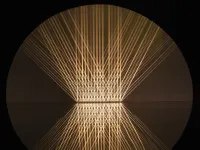
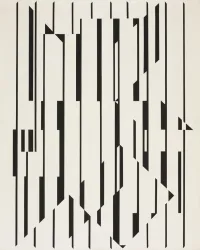
The Kunsthal Rotterdam exhibition 'Action <-> Reaction. 100 Years of Kinetic Art' presents an impressive historical overview of kinetic art, the abstract art movement from the twentieth century focusing on light and movement. Around eighty works of the most famous artists who made important contributions to the development of kinetic art can be admired. From pioneers such as Marcel Duchamp, Alexander Calder and Victor Vasarely, to established names such as Julio Le Parc, Gerhard von Graevenitz, Christian Megert, Bridget Riley, Yayoi Kusama, Jan van Munster and Dan Flavin as well as representatives from younger generations such as Jeppe Hein, Žilvinas Kempinas and Philippe Decrauzat. Also shown is work by Heinz Mack, Otto Piene and Günther Uecker of the German avant-garde group Zero.
In 2018, over a century after the birth of this art movement, and in close collaboration with the Réunion des musées nationaux – Grand Palais, Paris, the Kunsthal Rotterdam is proud to present ‘Action <-> Reaction’ in the Netherlands, a prestigious retrospective exhibition, placing the kinetic art of yesterday in the context of the performative arts of today.
The exhibition is subdivided into twelve themes covering different aspects of perception and phenomenal experience, such as light, movement, rhythm, structure, vibration, space, radiance, immateriality and rotation. All artworks appeal to various senses and, as a result of interacting with the viewer, can lead to extraordinary perceptions. Feel, see, hear and experience the rhythms, vibrations, spinning and force fields: Action <-> Reaction!
Highlights
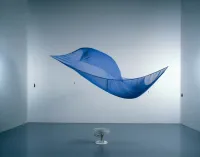
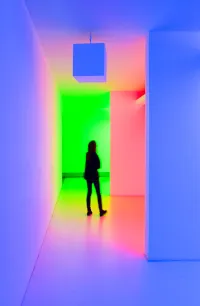
The exhibition ‘Action <-> Reaction' features many hallucinatory artworks. The monumental work ‘Mechanisches Ballett’ by Heinz Mack from 1963 that previously only existed as a model, will be constructed for the first time and have its world premiere in Rotterdam. Part of this work that contains references to Fernand Léger and Oskar Schlemmer, is a light and sound show with music by the composer György Ligeti. The 1964/65 work ‘Blaues Segel’ by the German artist Hans Haacke, consisting of a bleu piece of fabric across which a ventilator causes continuous undulating movements, is of a great sculptural and abstract beauty. The artificial light spaces in the work ‘Chromosaturation’ from 1965 by Carlos Cruz-Diez immerse the viewer in an environment that consists of only three colours and enables our eyes – used to perceiving a broad range of colours – to transform the idea of colour to an almost physical experience.
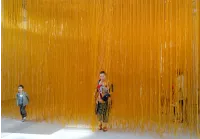
The sensory installation ‘Penetrable’ by the Latin-American artist Jesús Rafael Soto invites the viewer to become one with the artwork. This playful work consists of a closed curtain made from thousands of little yellow plastic threads – of which the shape is continually changing as a result of human contact – into which the visitors can disappear.
The artworks in the exhibition, including a number of monumental installations (environments), originate from famous collections of various museums in Europe and are brought together by the renowned French guest curator Serge Lemoine (former Président of Musée d’Orsay, Paris, and Professor emeritus at Sorbonne University, Paris) and Marianne Le Pommeré (Historian of Art).
History of kinetic art
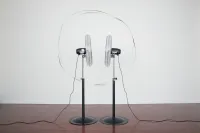
Concepts such as space, movement, vision and light punctuated the abstract art of the twentieth century, as a reaction to the scientific and technical advances of that age. After World War II, kinetic art started playing an important role in dematerialising art. Art can only really become art when it is seen or experienced by the viewer. From 1955, when the Paris exhibition ‘Le Mouvement’ takes place at the Denise René gallery, a number of developments all started to fall into place. Marcel Duchamp’s spinning ‘rotoreliefs’, Alexander Calder’s mobiles and the work of Jean Tinguely marked the beginning of movement art. The exhibition ‘Action <-> Reaction' also shows work by some of the movement’s predecessors, including Giacomo Balla, Hans Richter, François Morellet and László Moholy-Nagy who were the first to try and express abstract and dynamic concepts of reality through painting, sculpture and film.
Catalogue
The exhibition will be accompanied by a richly illustrated catalogue, published by Lannoo with contributions by Serge Lemoine and Marianne Le Pommeré.
This exhibition is realised in close collaboration with the Réunion des musées nationaux - Grand Palais, Paris.
Partners






About your visit
Frequently Asked Questions
Skip listThe Kunsthal is open from Tuesday to Sunday, from 10:00 to 17:00 hrs. The Kunsthal Café opens half an hour earlier, so you can visit from 9:30 hrs until half an hour after closing time. Check the current opening hours.
Yes, you need to book a ticket with a start time in advance. This also applies if you have a Museum card, Rotterdam pass, or VriendenLoterij VIP Card. This way, you are guaranteed admission and we can ensure that your visit is as pleasant as possible. Book your start time.
Yes, with an online ticket, you can visit all the exhibitions that are on display on the date of your visit. You can also stay as long as you like. You are welcome at the Kunsthal from your designated start time until closing time. Book your start time.
In de Kunsthal Rotterdam zijn altijd meerdere wisselende en contrastrijke tentoonstellingen tegelijk te zien. Een volledig overzicht van alle actuele tentoonstellingen vind je op de tentoonstellingspagina.